Security product
SuddenGone: sealed until a family needs it
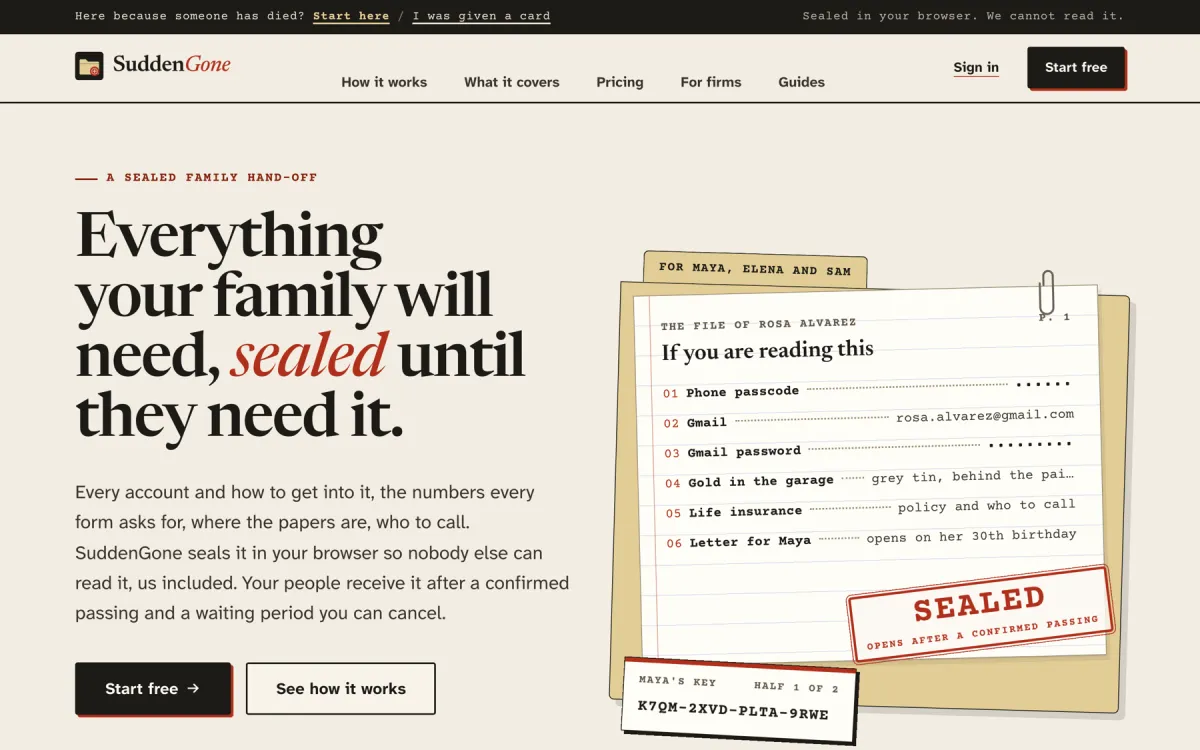
Everything your family will need, sealed until they need it. Encrypted in the browser, released only after a confirmed passing.
Live: suddengone.com
The problem
After a sudden death, a family has to find every account, policy and paper, usually with no list to start from. The phone has a passcode and the email has a password, and almost everything else resets through those two. The information exists only in one person's head. The hard part is not the encryption. It is designing a release process that is hard to abuse and impossible to trigger by silence.
What I built
- A complete hand-off file. Accounts and how to get into them, the numbers every form asks for, where the papers are, who to call, and letters that open on a chosen date.
- Sealed in the browser. Everything is encrypted on the person's own device before it is saved. The service stores ciphertext and cannot read it.
- A split key. Each person you name gets a printed card holding half of the key. The other half is released only after a confirmed passing.
- Release that cannot be gamed. A report needs a death certificate, human approval, independent confirmation by someone other than the reporter, and a waiting period. Any sign-in or check-in during the wait cancels it.
- Never presumed dead. Silence never releases anything. Someone in hospital or out of reach can be marked "alive but can't check in", and the owner can pause for up to a year.
- For firms too. Plans for advisers who look after many families, with the same release rules.
Architecture
The service never holds the whole key and never holds readable data. Release needs several independent confirmations, and any sign of life from the member during the waiting period stops it. Those rules are product promises, so each one is covered by a guard test.

Decisions and trade-offs
- Client-side encryption. PBKDF2 (600,000 iterations) and AES-GCM through WebCrypto, plus a recovery code the member keeps.
- Activity checks against false reports. Account activity after the claimed date flags the report and forces an official check and the longest wait.
- Release never depends on payment. Billing stops at release, and an unpaid account still opens for the family.
- Guard tests on product rules. The core promises (we can't read it, silence never releases) cannot regress quietly.
- Everyday security, with two-step sign-in, a device list and alerts, CSV import of saved logins, and per-person previews of exactly what each person will receive.
What it shows about how I lead
I started from the worst case, a false report or a family that cannot get in, and designed the process around it, then wrote the promises as tests. It is the same habit I apply to platform and security work: define what must never happen, make it checkable, and keep it checkable as the code changes.
Stack
Next.js · TypeScript · WebCrypto · Postgres · Stripe and PayPal · Cloudflare (WAF, Access, Turnstile) · Node test runner