Multi-tenant SaaS
ERPSav: finding money a business already overpaid
The cost recovery ERP. It finds money a business already overpaid and helps get it back.
Live: erpsav.com
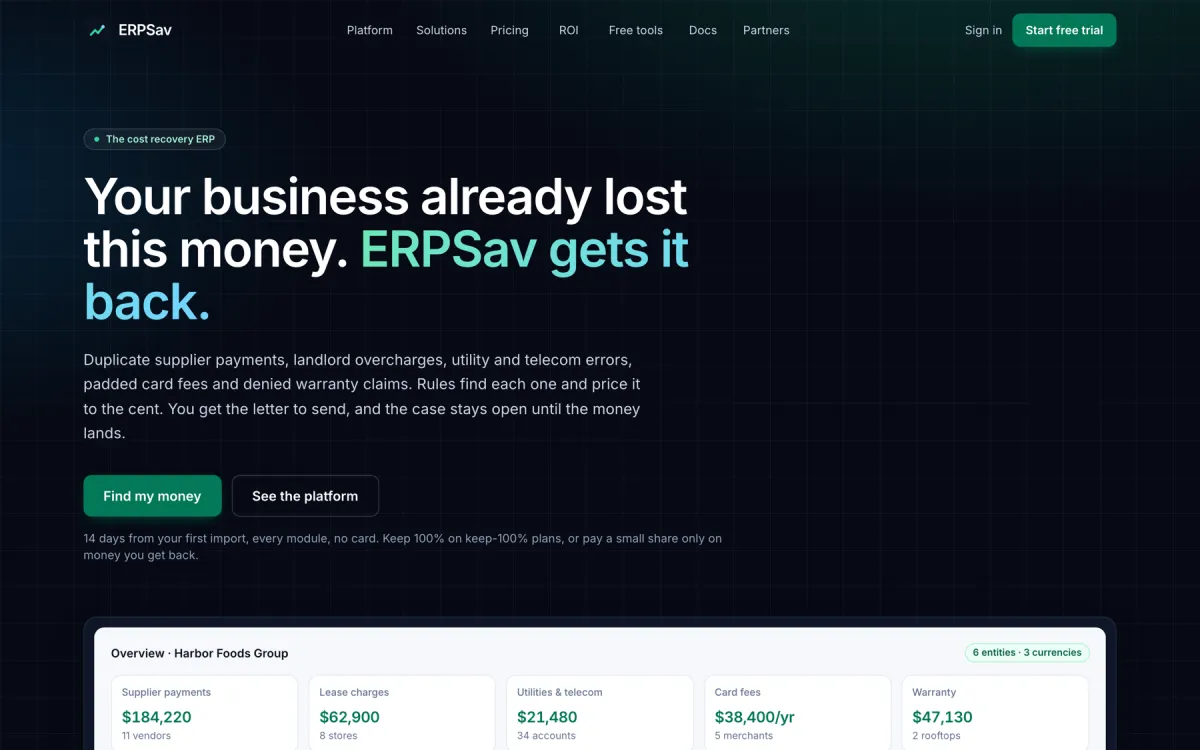
The problem
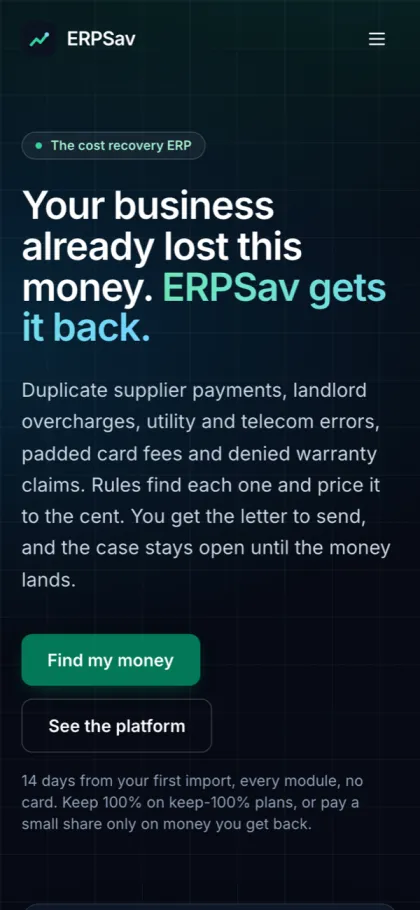
Businesses lose money in places nobody has time to check: duplicate supplier payments, landlord charges that break the lease, utility and telecom billing errors, padded card processing fees, and warranty claims that were denied and never appealed. Finding it by hand takes weeks. Getting it back takes letters, follow-ups and patience. ERPSav turns that into a pipeline: import, find, price, and follow up until the money lands.
What I built
- Recovery modules. Supplier payments, lease charges, utilities and telecom, card fees, warranty claims, late payment interest, VAT reclaim, customs drawback and customer deductions. Each module is its own engine behind one registry.
- Import without integration projects. Upload a CSV or PDF, or forward invoices to a per-workspace email address. Headers from common systems are recognised automatically, and every row that cannot be read comes back with a line number and a reason.
- Connectors. Connectors for accounting and payment systems, with credentials sealed at rest.
- Cases, not reports. Every finding becomes a case with a letter ready to send, and it stays open until the money lands.
- Built for teams and advisers. Multiple entities and currencies, agency workspaces, roles, two-step sign-in with recovery codes, and a referral partner programme.
Architecture
Each stage has one job. The parser turns messy exports into rows, or into a clear error with a line number. The rule engines turn rows into priced findings with no I/O. Cases and letters come last, and the only place a model touches the flow is the wording of the letter, which a person approves before it is sent.
Decisions and trade-offs
- Deterministic money. Every dollar figure comes from rules, never from a model. AI only drafts the wording, and a person approves it before anything is sent.
- No double counting. When several rules fire on the same line, the expected recovery is the single highest recoverable amount, not the sum.
- Hard stops win. Late submissions, missing returns and duplicates are marked not recoverable whatever else matched.
- Pure engines. The rule engines do no I/O and are fully unit tested, which makes new modules cheap to add and safe to change.
- Tenant isolation checks on every deploy. They run against production, including a check that a request for another workspace's record returns a real 404.
- Edge caching that respects app routing. Public pages are cached at the edge while app data requests stay private, which fixed a class of bugs where cached redirects bounced visitors.
- Statutory rate tables for late payment interest are versioned by half year.
What it shows about how I lead
The rule I hold hardest here is that numbers come from code that is tested and words come from a model that a person approves. It keeps the product trustworthy and keeps the AI useful. I would apply the same split in any regulated or financial setting: determinism where money or compliance is involved, models where language is.
Stack
Next.js (App Router) · TypeScript · Postgres · Stripe Billing with multi-currency prices · IMAP email ingestion · TOTP two-step sign-in · Cloudflare (WAF, Access, Turnstile, edge cache) · Node test runner